On this page
Last updated: 4 September 2026.
HVAC preventive maintenance software is useful when an Indian HVAC business needs to stop treating AMC visits as reminders in Excel and start treating them as assigned, verified field jobs.
For HVAC service companies in India, preventive visits protect customer comfort, commercial uptime, contract renewals, and technician capacity during seasonal peaks. A missed filter cleaning, coil inspection, gas-pressure check, or electrical check can become a breakdown call that disrupts the schedule and damages renewal trust.
Many HVAC teams still manage preventive maintenance through WhatsApp groups, paper registers, and memory. When the technician who "knows" a particular building's equipment leaves, the knowledge walks out with him.
This guide is for HVAC business owners and service managers who are ready to change that. You will learn exactly what HVAC preventive maintenance software does, which features matter for the Indian market, how to evaluate and compare options, how to calculate ROI in rupees, and how to implement it without disrupting your existing HVAC service operations.
We will cover angles that no competitor guide addresses: AMC automation for India's dominant service model, WhatsApp and UPI integration, GST compliance, India-specific seasonal maintenance schedules, and the growing world of solar HVAC PM.
Short answer
HVAC preventive maintenance software helps Indian HVAC service businesses schedule AMC visits, assign technicians, complete mobile checklists, capture proof-of-work photos, track equipment history, send service reports, and generate GST-ready invoices before failures happen. For Indian companies, the strongest fit is software that supports AMC automation, offline technician apps, WhatsApp reminders, UPI payment workflows, INR pricing, GST compliance, and mixed-brand HVAC asset tracking.
This page is about scheduled preventive maintenance and AMC visit execution. If your work is installation or multi-visit project execution, read HVAC project management software. If the problem is lead intake, OEM or CRM job imports, and customer follow-up, read HVAC customer management software. If you need the broad buying comparison, start with best HVAC software in India.
What Is HVAC Preventive Maintenance Software?
HVAC preventive maintenance software is a digital platform that helps HVAC service businesses plan, schedule, execute, and track maintenance activities before equipment fails — rather than responding after it breaks.
At its simplest, it is a system that answers four questions:
- What needs to be maintained? — An asset registry of every unit under your service
- When does it need attention? — Schedules based on time intervals, usage, or sensor readings
- Who does the work? — Technician assignment, routing, and skill matching
- Was it done correctly? — Digital checklists, photo evidence, and manager sign-off
Unlike a basic spreadsheet or calendar reminder, PM software connects these four elements into a single workflow. A schedule automatically generates a work order. The work order appears on the right technician's phone. The technician completes a checklist and uploads photos. The manager sees completion in real time. The asset history updates automatically. The customer gets a service report without anyone sending an email.
Preventive Maintenance vs Reactive Maintenance
Most Indian HVAC businesses today run on a reactive model, sometimes called "run-to-fail" maintenance. A unit breaks, the customer calls, a technician is dispatched, parts are sourced, the unit is repaired. This model has a comfortable familiarity — you only spend money when something actually goes wrong.
The problem is that reactive maintenance is far more expensive in the long run:
| Factor | Reactive Maintenance | Preventive Maintenance |
|---|---|---|
| Breakdown frequency | High (unplanned) | Low (prevented) |
| Emergency call-out cost | ₹2,000–₹5,000 per call | Eliminated |
| Parts cost | Premium (urgent sourcing) | Standard (planned procurement) |
| Technician travel | Unplanned, unoptimized | Batched, routed efficiently |
| Equipment lifespan | Shortened by stress | Extended by care |
| Customer complaints | Frequent | Rare |
| Contract renewals | At risk after each breakdown | Predictable, high |
The practical benefit is not only fewer breakdowns. A structured PM workflow gives the owner a cleaner view of due visits, missed visits, equipment history, material needs, technician workload, and renewal risk.
PM Software vs Basic CMMS
You may have heard the term CMMS — Computerized Maintenance Management System. Traditional CMMS software was designed for large industrial plants and is often expensive, complex, and built for desktop use. HVAC PM software is the modern, mobile-first evolution of that concept, designed specifically for service businesses rather than in-house facility teams.
The key differences:
- CMMS: Asset-centric, designed for facilities/manufacturing, often requires IT support
- HVAC PM Software: Service-business-centric, mobile-first, built for technicians in the field
For most Indian HVAC service companies — whether you manage 50 AMCs or 5,000 — dedicated HVAC PM software will be more practical, faster to implement, and more affordable than a full CMMS platform.
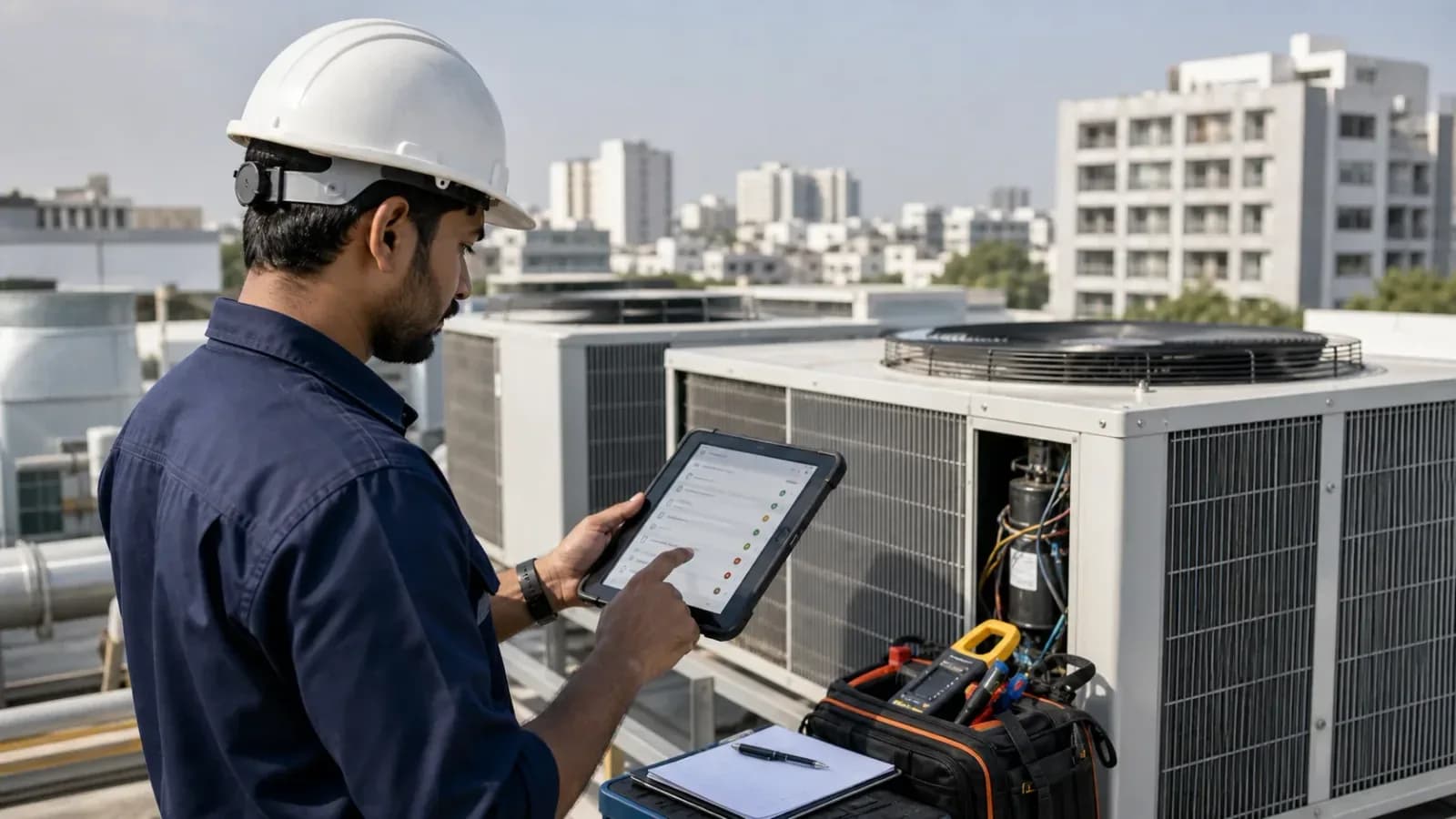 HVAC technician using preventive maintenance software on a tablet during equipment inspection
Modern HVAC PM software gives technicians real-time checklists and equipment history on mobile devices.
HVAC technician using preventive maintenance software on a tablet during equipment inspection
Modern HVAC PM software gives technicians real-time checklists and equipment history on mobile devices.
Key Features to Look For in HVAC PM Software
Not all HVAC preventive maintenance software is built the same. For Indian businesses specifically, there are features that global products often skip entirely. Here is a comprehensive feature evaluation framework.
1. Asset Registry and Equipment Database
Every unit you maintain should have a digital record: brand (Voltas, Daikin, Blue Star, Carrier, Hitachi, Mitsubishi), model, serial number, installation date, warranty expiry, service history, and location.
Good HVAC PM software lets you:
- Import your existing asset list from Excel or CSV
- Add equipment photos for easy identification
- Record installation documents and manuals
- Set equipment-specific PM schedules (a rooftop packaged unit needs different tasks than a split AC)
- Track warranty dates and flag expiring warranties
India-specific need: Multi-brand support is essential. Indian HVAC fleets are typically mixed — a commercial building might have Voltas cassette units, Daikin VRF, Blue Star chillers, and Hitachi splits all under one AMC. Your software must handle different PM checklists for different equipment types.
2. PM Schedule Automation
This is the core feature: automatic generation of maintenance tasks based on rules you define.
Schedule types to look for:
- Time-based: Every 30, 60, 90 days; every 6 months; annually
- Usage-based: After X hours of operation (requires IoT integration or manual meter readings)
- Seasonal: Summer pre-season check (March–April), monsoon check (June), winter preparation (November)
- Event-triggered: After a repair, after a warranty claim, after a customer complaint
A good system will surface upcoming PM work 2–4 weeks in advance, allowing you to batch jobs by location, assign the right technician, and procure any parts needed.
India-specific need: Seasonal scheduling is critical for India's climate. Pre-summer (March–April) is the busiest season for HVAC PM in most of India. Your software should support seasonal bulk scheduling so you can send 50 pre-summer service calls in one go rather than managing them one by one.
See our HVAC preventive maintenance checklist for a complete seasonal task list.
3. Work Order Management
PM schedules must automatically generate work orders — job cards that tell a technician exactly what to do, with the equipment history, checklists, and required parts ready before they arrive.
Essential work order features:
- Auto-generation from PM schedules
- Technician assignment (manual or skill-based auto-assignment)
- Priority levels (routine PM, urgent PM, emergency)
- Parts and materials attached to the job
- Customer approval workflows (for larger jobs)
- Digital sign-off by customer on completion
For a deeper look, see our guide on work order management software for HVAC companies.
4. Mobile App for Field Technicians
The software is only as good as the experience for the technician on the ground. A poor mobile app means technicians skip it or work around it, making the whole system unreliable.
Mobile app must-haves:
- Works offline (critical for basements, server rooms, locations with poor connectivity)
- Digital checklists with mandatory fields
- Photo and video attachment
- Barcode/QR code scanner to identify equipment
- GPS-stamped clock-in / clock-out
- Parts usage recording
- Customer signature capture
India-specific need: Many HVAC technicians in India are comfortable with WhatsApp but may find unfamiliar apps challenging. Look for software with a simple, WhatsApp-like interface, and ideally one that can send job notifications via WhatsApp. See our guide on moving service calls beyond WhatsApp for how leading Indian HVAC companies are bridging this gap.
 HVAC service team using mobile field service management app
HVAC service teams in India increasingly rely on mobile apps to coordinate preventive maintenance visits.
HVAC service team using mobile field service management app
HVAC service teams in India increasingly rely on mobile apps to coordinate preventive maintenance visits.
5. AMC (Annual Maintenance Contract) Management
This is the feature that separates HVAC-specific PM software from generic tools, and it is the most important feature for the Indian market.
AMC management means:
- Storing all AMC contracts with start/end dates, covered equipment, terms, and pricing
- Auto-generating PM visits as per the contracted schedule
- Tracking visits completed vs visits contracted
- Sending renewal reminders 60, 30, and 15 days before expiry
- Managing multi-site AMCs (one contract, multiple locations)
- Generating AMC performance reports for customers
- Handling AMC invoicing with GST breakup
India's AMC model is the dominant commercial relationship for HVAC service companies. Most competitors — especially US-based products — do not understand this model at all. A generic work order system will not handle AMC contract terms, renewal tracking, or the multi-visit scheduling that AMC customers expect.
Our modern HVAC service center guide covers this in detail, and our AMC management software India guide explains the contract-to-renewal workflow across service industries. The short version: if a software vendor cannot clearly demonstrate how their system handles Indian-style AMCs, look elsewhere.
6. Inventory and Parts Management
HVAC PM generates predictable parts demand — filters, capacitors, refrigerant, belts, contactors. Software that connects PM schedules to inventory helps you stock the right parts before jobs rather than scrambling after arrival.
Look for:
- Parts consumption tracking per job
- Low-stock alerts for commonly used items
- Parts cost included in job profitability calculation
- Integration with distributors (Havells, Anchor, local dealers)
- GST-compliant parts invoicing
If PM visits consume parts from technician bags or branch stock, inventory should not be checked only at month end. The spare parts inventory management software guide explains how to track stock from godown to technician job card, unused return, defective return, and billing handoff.
7. Reporting and Analytics
A dashboard that shows you PM compliance rate, upcoming overdue jobs, technician productivity, and equipment breakdown frequency turns raw data into business decisions.
Essential reports:
- PM compliance rate (% of scheduled jobs completed on time)
- Equipment breakdown frequency (before and after PM program)
- Technician utilization rate
- First-time fix rate (jobs completed without a return visit)
- AMC renewal rate
- Customer satisfaction score (from post-visit ratings)
India-specific need: Reports with GST-inclusive billing, reports segmented by region/city (critical for multi-city operations), and reports exportable in formats compatible with Tally or Zoho Books.
8. Customer Portal and Communication
Customers who can see their PM history and upcoming scheduled visits do not call asking "when was the last service?" They also renew AMCs at higher rates because they have visible proof of value.
Look for:
- Customer-facing portal or app showing their equipment's PM history
- Automated service reminders (SMS, email, WhatsApp)
- Digital service reports sent automatically after each visit
- Customer ratings for each visit
- Online payment for AMC renewals (UPI, net banking, cards)
India-specific need: UPI payment integration is a significant differentiator in the Indian market. HVAC businesses that offer UPI-based AMC renewals see faster renewal payments and fewer follow-up calls. Our field service management software guide covers digital payment integration in detail.
9. GST Compliance
Any HVAC PM software used in India must handle GST correctly. This means:
- HSN/SAC code assignment for services and parts
- GST rate selection (18% for most HVAC services)
- GSTIN capture for B2B customers
- GST-compliant invoice format
- Input tax credit tracking
- Export to GSTN-compatible formats for filing
Surprisingly, many popular global HVAC software products fail this basic requirement. Always verify GST compliance before purchase.
Top HVAC Preventive Maintenance Software for Indian Businesses
| Software | Best For | India Features | Starting Price (INR) | GST Compliant | Mobile App |
|---|---|---|---|---|---|
| KaryaFlow | HVAC SMBs, AMC-heavy businesses | WhatsApp, UPI, AMC, GST, multilingual | ₹990/month up to 10 users | Yes (full) | Excellent |
| FieldEZ | Mid-size field service teams | Partial India features | ₹1,500/user/month | Partial | Good |
| Zoho FSM | Zoho ecosystem users | Zoho Books integration | ₹1,600/user/month | Yes | Good |
| Limble CMMS | Facilities/in-house maintenance | US-focused | ~₹4,000/user/month | No | Good |
| BuildOps | Large HVAC contractors | US-focused | ~₹8,000+/user/month | No | Excellent |
| ServiceMax | Enterprise (100+ technicians) | Enterprise-grade | ₹12,000+/user/month | Partial | Good |
Competitor pricing as of April 2026. KaryaFlow pricing as of September 24, 2026, plus 18% GST. Verify current pricing with vendors.
What to Watch Out For
Global products not built for India: Limble, BuildOps, and ServiceMax are excellent products — for the US market. They lack GST compliance, INR pricing pages, India-specific support, AMC model understanding, and WhatsApp/UPI integrations. They can be made to work, but with significant configuration effort and workarounds.
Free tools with hidden limits: Several free options (Google Sheets + Calendar, Trello, Notion) appear to work initially but break down as your business scales. They have no audit trail, no offline mobile support, and no customer-facing reports.
Overly complex CMMS products: Full industrial CMMS platforms are designed for 50-person IT teams. An HVAC service company with 10–50 technicians does not need (and cannot practically deploy) an SAP-level maintenance system.
How to Implement HVAC PM Software in 7 Steps
Implementation is where most software purchases fail — not because the software is bad, but because the rollout is rushed or the team is not prepared. Follow this 7-step process for a smooth implementation.
 HVAC maintenance analytics dashboard showing equipment health and PM completion rates
PM software dashboards give HVAC business owners a real-time view of maintenance compliance across their fleet.
HVAC maintenance analytics dashboard showing equipment health and PM completion rates
PM software dashboards give HVAC business owners a real-time view of maintenance compliance across their fleet.
Step 1: Audit Your Current Asset Base (Week 1)
Before you touch the software, get your asset data in order.
Create a spreadsheet with every HVAC unit you are responsible for:
- Customer name
- Site address
- Unit brand and model
- Serial number
- Installation date (approximate if unknown)
- AMC start and end dates
- Last service date
This is painful but essential. Businesses that skip this step spend weeks chasing phantom equipment and explaining to software support why the auto-generated PM schedules are wrong.
Tip: Send a WhatsApp message to each of your key technicians asking them to list all units at their regular sites. You will get 80% of the data within 24 hours.
Step 2: Define Your PM Templates (Week 1–2)
A PM template is the checklist a technician follows for a specific equipment type. Common templates for Indian HVAC:
Split AC (Residential/Commercial):
- Clean/replace air filter
- Clean evaporator and condenser coils
- Check refrigerant pressure and top up if needed
- Clean drain pan and pipe
- Check electrical connections and capacitor health
- Test thermostat and controls
- Check fan motor current draw
- Record indoor and outdoor temperature differential
- Check and tighten all screws and fixings
- Customer sign-off
Chiller (Centrifugal/Screw):
- Check oil level and quality
- Check refrigerant levels
- Test safety controls and interlocks
- Clean strainers and filters
- Check vibration levels
- Inspect all valves and actuators
- Check condenser water treatment
- Log all parameters against baseline
VRF/VRV System:
- Check outdoor unit fan and coil
- Verify refrigerant pressures at all indoor units
- Check communication wiring
- Test defrost cycle
- Clean indoor unit filters at all zones
- Check and test remote controllers
Build templates for every equipment type in your fleet. The HVAC preventive maintenance checklist on our site provides ready-made templates you can adapt.
Step 3: Configure AMC Schedules (Week 2)
Enter each AMC contract into the system:
- Customer name, GSTIN, address
- Contract start and end dates
- Equipment covered
- Visit frequency (quarterly, bi-annual, annual)
- Contract value and payment terms
- Special terms (24-hour response, 48-hour parts, emergency callout rate)
The software should then auto-generate PM visits for the contract period. Review the generated schedule — it should show you the next 6–12 months of PM work across all contracts.
This step typically reveals scheduling conflicts: too many jobs in April–May (pre-summer rush), not enough in November–December. You can redistribute visits or add resources accordingly.
Step 4: Onboard Your Technicians (Week 2–3)
Technician adoption is the biggest risk in implementation. Address it directly:
- Run a 1-hour group training session
- Have them install the mobile app on their own phones
- Do a practice job with a real (but low-stakes) PM visit
- Appoint one "power user" technician per team as the go-to for questions
- For the first two weeks, have a manager review all completed jobs and give feedback
Keep it simple. Most technicians do not need to know how the system works — they need to know: open the app, find today's job, open the checklist, fill it in, take photos, submit.
India-specific note: If your technicians speak Hindi or a regional language, look for software with multilingual support. Asking a technician in Tier-2 city to use English-only software dramatically reduces adoption.
Step 5: Run Parallel Operations for 2 Weeks (Week 3–4)
Do not switch off your old system on day one. Run both in parallel:
- Continue WhatsApp group coordination
- Also assign all jobs through the new software
- Compare: are all jobs appearing correctly? Are technicians completing checklists? Are schedules accurate?
Use this period to catch configuration errors (wrong equipment assigned, wrong PM frequency, incorrect customer details) before they affect live AMC commitments.
Step 6: Go Live with Customer-Facing Features (Week 4–6)
Once internal operations are stable, activate customer-facing features:
- Send customers a link to their service portal
- Enable automated post-visit reports
- Switch AMC renewal reminders to the new system
- Enable UPI payment links on renewal notices
This is often where businesses see the most immediate business impact. Customers who receive automated reports and renewal reminders are significantly more likely to renew on time.
Step 7: Review and Optimize (Month 2 Onward)
After 30 days of full operation, review your PM compliance report. Key questions:
- What percentage of scheduled PMs were completed on time?
- Which technicians are consistently late or skipping steps?
- Which customers have the most breakdown calls despite PM?
- Are there equipment types failing more than expected?
Use this data to adjust PM frequency, update checklists, and address technician performance. The goal is a PM compliance rate above 90% within 3 months.
Preventive vs Predictive Maintenance: What's the Difference for HVAC?
Preventive maintenance is scheduled based on time or usage. Predictive maintenance is triggered by equipment data — sensors detecting anomalies before a failure occurs.
For most Indian HVAC businesses in 2026, predictive maintenance is emerging as a complement (not replacement) to structured preventive maintenance. Understanding the distinction helps you plan the right technology roadmap.
| Factor | Preventive | Predictive |
|---|---|---|
| Trigger | Calendar/usage schedule | Sensor data anomaly |
| Technology needed | PM software + mobile app | PM software + IoT sensors |
| Cost | Low–medium | Medium–high (sensors add cost) |
| Accuracy | Good — catches most issues | Better — catches subtle failures |
| Best for | All HVAC businesses | Businesses with high-value, critical equipment |
For 2026: Start with preventive maintenance software. It delivers 70–80% of the benefit of predictive maintenance at a fraction of the cost and complexity. As your data matures and IoT sensor costs fall (they have dropped 60% in 3 years), you can layer in predictive capabilities.
Our guide on predictive vs preventive maintenance covers the IoT-integration roadmap in detail.
 Commercial HVAC system requiring scheduled preventive maintenance
Large commercial HVAC systems in Indian buildings need structured PM schedules to avoid costly breakdowns.
Commercial HVAC system requiring scheduled preventive maintenance
Large commercial HVAC systems in Indian buildings need structured PM schedules to avoid costly breakdowns.
The IoT-based HVAC monitoring guide covers sensor-based predictive maintenance for businesses ready to take that next step.
ROI of HVAC PM Software: A Rupee-by-Rupee Breakdown
Let's calculate the real ROI for a mid-size Indian HVAC service company: 5 technicians, 200 AMC contracts, average AMC value ₹8,000/year.
Annual revenue from AMCs: ₹16,00,000
Cost Savings from PM Software
1. Reduced emergency breakdowns
- Before PM software: 3–4 emergency calls per technician per month = 180–240 calls/year
- After PM software: 1–2 calls per technician per month = 60–120 calls/year
- Reduction: ~120 emergency calls avoided
- Cost per emergency call (parts + overtime + customer goodwill): ₹3,000 average
- Annual savings: ₹3,60,000
2. Improved technician routing efficiency
- Before: Unplanned routing, 30–40 km/day wasted travel
- After: Batched PM visits, 15–20 km/day saved
- Fuel savings per technician: ₹1,500/month
- 5 technicians × ₹1,500 × 12 months = ₹90,000/year
3. Reduced parts wastage
- Planned PM allows bulk procurement at better prices vs emergency sourcing
- Estimated savings: 12–15% on parts cost
- If annual parts spend is ₹3,00,000: ₹36,000–₹45,000 savings
4. Higher AMC renewal rate
- Before PM software: 65–70% renewal rate (industry average)
- After PM software with automated reminders and service reports: 80–85%
- Additional renewals: 30 contracts × ₹8,000 = ₹2,40,000 additional revenue
5. Faster invoicing and payment collection
- Manual invoicing: 15–30 days to issue, 45–60 days to collect
- Automated invoicing with UPI links: Issued same day, collected in 7–10 days
- Working capital improvement: ~₹2,00,000 better cash flow
Total Annual Benefit
| Benefit | Amount (INR) |
|---|---|
| Emergency breakdown reduction | ₹3,60,000 |
| Routing efficiency | ₹90,000 |
| Parts procurement savings | ₹40,000 |
| Additional AMC renewals | ₹2,40,000 |
| Working capital improvement (cash flow) | ₹2,00,000 |
| Total annual benefit | ₹9,30,000 |
Cost of PM Software
- KaryaFlow Starter, which covers up to 10 users: ₹9,900/year, or ₹11,682/year with 18% GST — see KaryaFlow pricing
- Implementation and onboarding: ₹0 (self-service)
- Training time (5 technicians × 4 hours): One-time
Net annual ROI: ₹9,30,000 − ₹11,682 = ₹9,18,318 ROI: about 7,860%
Use our field service ROI calculator to run the numbers for your specific business size and AMC value.
India-Specific Considerations for HVAC PM Software
HVAC PM software in India needs local operating details that many international HVAC software guides skip because those guides are designed for a different market.
The AMC Model in India
Annual Maintenance Contracts (AMCs) are the dominant commercial model for Indian HVAC service businesses. An AMC is a fixed-price contract where the service company commits to a specified number of PM visits, emergency response time, and in some cases spare parts coverage.
Most international HVAC software is designed around a "time and materials" model: customer calls, technician goes, customer pays per visit. The AMC model is fundamentally different:
- Revenue is collected upfront or in installments
- The service company must proactively schedule visits (not wait for calls)
- Contract terms define what is and is not covered
- Renewal is an active sales process, not automatic
Your PM software must explicitly support AMCs — tracking visits against contract commitments, managing coverage terms, and automating renewals. See our AMC management software guide for a complete breakdown.
WhatsApp as a Workflow Tool
WhatsApp is not just a messaging app in India — it is critical business infrastructure. Most HVAC technicians receive job assignments via WhatsApp. Most customers confirm appointments via WhatsApp. Most equipment photos are shared via WhatsApp.
The best HVAC PM software for India integrates with WhatsApp Business API to:
- Send job notifications to technicians (with one-tap accept)
- Send appointment reminders to customers
- Share service reports as PDF links
- Send AMC renewal notices with UPI payment links
- Receive customer feedback after visits
This is not a nice-to-have for Indian HVAC businesses — it is how your team actually communicates. Software that ignores this creates parallel workflows and reduces adoption. Read our WhatsApp for field service guide to understand the integration patterns that work.
UPI and Digital Payments
UPI has transformed B2B payments in India, not just consumer transactions. For HVAC service companies, UPI integration means:
- Customers can pay AMC renewal invoices via QR code or link
- Technicians can collect on-the-spot payments for additional work
- Advance payments for large PM projects are faster to collect
- Payment confirmation is automatic — no manual reconciliation
The impact on cash flow is significant. HVAC companies that add UPI payment links to invoices and renewal notices typically see their average collection time drop from 45 days to under 10 days.
GST Compliance in HVAC Service
HVAC services in India are taxable at 18% GST (SAC code 998719 for maintenance and repair of HVAC equipment). Parts replacement during PM visits is taxable at applicable GST rates (12–18% depending on the component).
PM software must handle:
- Service tax: 18% GST on labour/service charges
- Parts tax: Correct rate per HSN code (5%, 12%, or 18% depending on the part)
- Composite supply treatment: When service and parts are billed together
- B2B invoicing: GSTIN required for ITC-eligible customers
- Reverse charge: For certain commercial property situations
- GST-compliant invoice format: GSTIN, HSN/SAC, tax breakup
Non-compliance can mean penalties and customer disputes over ITC claims. Verify GST compliance carefully before selecting any software.
India's Seasonal HVAC Calendar
India's climate creates a predictable PM demand cycle that your scheduling system should reflect:
March–April (Pre-Summer Rush):
- Full service for all AC units before peak heat
- Filter cleaning, coil cleaning, refrigerant check
- Highest demand period — book technicians 3–4 weeks in advance
- Use batch scheduling to handle the surge
June–July (Monsoon Check):
- Drainage inspection (clogged drains cause water damage during monsoon)
- Mould and microbial growth check in humid climates
- Outdoor unit protection in heavy rainfall zones
September–October (Post-Monsoon):
- Full filter replacement cycle
- Electrical connections check (moisture ingress during monsoon)
- Refrigerant pressure verification
November–December (Pre-Winter, North India):
- Heating mode testing for split ACs with heat pump function
- Heat exchanger cleaning
- Gas boiler/chiller shutdown or winterisation for North India
February (Pre-Season Preparation):
- Equipment warranty expiry check
- AMC renewal push before April rush
See our seasonal HVAC maintenance schedule guide for detailed India-specific PM checklists by season.
Tier-2 and Tier-3 City Deployment
India's HVAC market is growing fastest in Tier-2 and Tier-3 cities — Nashik, Surat, Jaipur, Coimbatore, Indore — where commercial construction is booming and AC penetration is rising rapidly.
Deploying PM software in these markets comes with specific challenges:
Connectivity: Mobile internet can be intermittent. Your software must work offline — checklists must be fillable without connectivity, and data must sync when connectivity returns.
Language: Technicians in smaller cities often prefer Hindi or regional languages. English-only apps see lower adoption. Look for software with Hindi language support at minimum.
Training: Formal IT training is less common. The app interface must be extremely simple — ideally icon-driven and step-by-step, similar to a WhatsApp conversation.
Equipment diversity: Tier-2 cities often have older equipment, more local/lesser-known brands, and less standardised PM requirements. Your PM templates should be flexible enough to accommodate this.
Solar HVAC Preventive Maintenance
Solar-powered and solar-hybrid HVAC systems are a rapidly growing segment in India, driven by:
- Commercial solar installations on rooftops (mandatory under some state policies)
- Cooling + solar projects in hospitals, warehouses, and data centres
- Government schemes like PM-KUSUM pushing solar in rural areas
Solar HVAC PM is distinct from conventional HVAC PM:
- Solar panel inspection must be added to PM checklists (dust accumulation in India's dry regions can cut output by 30%)
- Inverter health checks (HVAC variable frequency drives paired with solar inverters)
- Battery storage monitoring for off-grid and hybrid systems
- Energy yield verification — PM software should track actual vs expected energy generation
Most HVAC PM software has no understanding of solar HVAC. This is a significant differentiation opportunity for Indian HVAC businesses that are building solar service practices.
 Solar-powered HVAC system installation requiring specialized preventive maintenance software
Solar HVAC systems are a fast-growing segment in India that requires dedicated PM tracking.
Solar-powered HVAC system installation requiring specialized preventive maintenance software
Solar HVAC systems are a fast-growing segment in India that requires dedicated PM tracking.
Multi-Brand HVAC Fleet Management
A large commercial AMC in India will typically cover equipment from multiple manufacturers: Voltas, Daikin, Blue Star, Carrier, Mitsubishi, Hitachi, LG, Samsung. Each brand has different PM requirements, parts sourcing channels, and technical documentation.
Your PM software should support:
- Brand-specific PM checklists (not just a generic HVAC checklist)
- Parts catalogue by brand (so technicians know what to stock)
- Warranty tracking per manufacturer terms
- Escalation to manufacturer service network when needed
- Integration with manufacturer service portals (where available)
Real-World Case Studies
Case Study 1: Multi-Site Commercial AMC in Pune
Illustrative example based on typical outcomes reported by HVAC businesses using PM software. Details are representative, not from a specific named customer.
Business: A 12-technician HVAC service company managing 450 AMC contracts across commercial offices and retail in Pune
Before PM software:
- PM schedules tracked in Excel, updated weekly
- 35% of PM visits missed or delayed each month
- AMC renewal rate: 62%
- Average emergency calls per month: 28
After implementing KaryaFlow PM software (6 months):
- PM compliance rate: 91%
- AMC renewal rate: 79% (17 additional contracts)
- Average emergency calls per month: 11 (61% reduction)
- Additional revenue from renewals: ₹1.36 lakh/month
Key driver: Automated renewal reminders and digital service reports with visit photos made the value of the AMC visible to customers who previously questioned why they were paying.
Case Study 2: Residential AC Service Chain in Chennai
Illustrative example based on typical outcomes reported by HVAC businesses using PM software. Details are representative, not from a specific named customer.
Business: A growing residential AC service business — 8 technicians, 180 AMCs, expanding to second location
Challenge: Managing PM schedules across two locations with separate technician teams, while maintaining quality consistency
Solution: Implemented PM software with location-based scheduling and technician routing
Results after 4 months:
- Technician travel time reduced by 22%
- Customer complaints about missed services reduced from 8–10 per month to 1–2
- New location reached AMC breakeven 2 months ahead of projection
- PM compliance: 88%
Key driver: Location-based job assignment meant technicians were being sent to nearby jobs in a logical sequence rather than cross-city routing driven by who was available.
FAQ: HVAC Preventive Maintenance Software
 HVAC technician completing digital preventive maintenance checklist on smartphone
Digital checklists replace paper forms and ensure every PM task is documented and traceable.
HVAC technician completing digital preventive maintenance checklist on smartphone
Digital checklists replace paper forms and ensure every PM task is documented and traceable.
What does HVAC preventive maintenance software do?
HVAC preventive maintenance software is a digital platform that helps HVAC service businesses schedule, execute, and track maintenance activities for the equipment they service. It automates the creation of PM work orders, provides technicians with mobile checklists, records all maintenance history, and manages AMC contracts and renewals. Unlike spreadsheets or paper-based systems, PM software connects scheduling, field execution, customer communication, and billing into a single workflow.
How is HVAC PM software different from a CMMS?
A CMMS (Computerized Maintenance Management System) is designed for in-house maintenance teams at facilities (factories, hospitals, commercial properties). HVAC PM software is designed for service businesses — companies that maintain equipment at multiple customer locations. Key differences: HVAC PM software is mobile-first, supports AMC/contract billing, has customer-facing portals, and is built for technicians in the field rather than facility managers at a desk.
What does HVAC PM software cost in India?
Indian-optimized HVAC PM software typically starts at ₹800–₹1,500 per user per month. For a 5-technician team, expect ₹4,000–₹7,500/month. Enterprise platforms (BuildOps, ServiceMax) start at ₹6,000–₹12,000+ per user per month but are designed for the US market and lack India-specific features. Many providers offer annual plans at 20–30% discount. Always verify whether GST is included in the quoted price, and what support level is included.
Is HVAC PM software worth it for small businesses (2–5 technicians)?
Yes, especially if you manage AMC contracts. The ROI calculation is straightforward: if PM software prevents even 5 emergency callbacks per month (saving ₹15,000 in emergency costs) and improves your AMC renewal rate by 10% (adding ₹50,000–₹80,000 in annual revenue), the software pays for itself many times over. The administrative time savings — no more manually tracking PM schedules in Excel — is a secondary benefit that business owners consistently cite as transformative.
Does HVAC PM software work offline?
The best mobile apps for HVAC technicians work fully offline — technicians can open job cards, complete checklists, take photos, and submit reports without internet. Data syncs automatically when connectivity is restored. This is critical for basement plant rooms, server rooms, and Tier-2/Tier-3 city deployments where mobile internet can be unreliable. Always test offline functionality before committing to a platform.
How do I migrate my existing AMC data into new PM software?
Most HVAC PM software supports CSV import for customer lists, equipment assets, and AMC contracts. Prepare your data in a spreadsheet first: customer name, site address, equipment details (brand, model, serial number), AMC start/end dates, visit frequency, and last service date. Plan for 2–4 weeks of data entry and verification before going live. Some vendors offer paid onboarding services to migrate your data for you — this is often worth the cost for businesses with 200+ AMCs.
Can HVAC PM software integrate with Tally or Zoho Books?
Some HVAC PM platforms offer direct integration with Tally (via Tally Prime API) or Zoho Books (via Zoho integration). For others, you can export invoice data as CSV and import into your accounting system. When evaluating software, ask specifically about Tally integration if you use it — not all platforms support it, and manual data entry defeats much of the efficiency benefit. See our field service management software India guide for a list of accounting integrations.
What is the difference between a PM schedule and a work order in HVAC software?
A PM schedule is the rule that defines when maintenance should happen: "service unit X every 90 days" or "quarterly for all units under AMC contract Y." A work order is the actual job created from that rule: "Service 3 units at ABC Office on April 20, assigned to Technician Rajan." PM software automatically converts schedules into work orders at the right time, attached to the right equipment and customer, with the correct checklist pre-loaded.
How does HVAC PM software handle multiple technicians?
PM software assigns work orders to specific technicians based on criteria you define: availability, location, skill set, or workload balance. Technicians see only their assigned jobs. Managers see all jobs across all technicians. Advanced systems include route optimization — automatically sequencing a technician's daily jobs to minimize travel. For larger teams, skills-based routing ensures AC split specialists are not assigned to chiller maintenance.
Can customers see their PM history in HVAC PM software?
Yes — most HVAC PM platforms include a customer-facing portal or automated reports. Customers can log in to see all service visits, maintenance performed, equipment health, and upcoming scheduled visits. After each visit, an automated report (with photos taken during the job) is sent by email or WhatsApp. This transparency is one of the most effective tools for AMC renewal — customers who can see their PM history renew at significantly higher rates than those who cannot.
How does WhatsApp integration work in HVAC PM software?
WhatsApp Business API integration allows PM software to send job notifications, appointment reminders, service reports, and AMC renewal notices via WhatsApp — the channel most Indian technicians and customers already use. Technicians receive a WhatsApp message with job details and can tap to accept or flag an issue. Customers receive appointment reminders and post-visit reports as WhatsApp messages with PDF attachments. This is fundamentally different from just copying a link — it is a direct workflow integration. Our WhatsApp for field service guide covers setup in detail.
Does HVAC PM software support GST invoicing?
Any HVAC PM software built for the Indian market should fully support GST invoicing: correct SAC codes (998719 for maintenance services), appropriate GST rates for services (18%) and parts (varies by HSN code), GSTIN capture for B2B customers, and GST-compliant invoice format. Verify this explicitly before purchasing — many global products generate invoices that do not meet Indian GST requirements, creating compliance headaches.
What is an AMC management feature in HVAC software?
AMC (Annual Maintenance Contract) management is a specialized feature that stores contract terms, auto-generates PM visits as per the contracted schedule, tracks visits delivered vs contracted, sends renewal reminders before expiry, generates AMC performance reports, and handles AMC billing (including part-year contracts and multi-site contracts). This is essential for Indian HVAC businesses, where AMCs are the primary commercial model. Generic field service software without dedicated AMC management will require significant manual workaround.
How many PM schedules can HVAC software handle?
There is no practical upper limit for modern cloud-based HVAC PM software. A business with 5,000 assets under AMC can have 5,000 separate PM schedules, each with different frequencies, checklists, and assigned technicians. The system handles the complexity of generating, assigning, and tracking all of them automatically. For very large operations (10,000+ assets), verify the vendor's performance benchmarks and customer references at that scale.
What reports does HVAC PM software generate?
Standard reports include: PM compliance rate (% of scheduled jobs completed on time), technician utilization (jobs per day, hours worked), equipment breakdown frequency (breakdown trend before/after PM), first-time fix rate (jobs completed without return visit), AMC renewal rate and revenue, customer satisfaction scores, parts consumption and cost per equipment type, and financial reports (revenue by job type, by customer, by period). Advanced systems add predictive reports: equipment nearing failure based on pattern data, contracts at renewal risk based on service history.
Can HVAC PM software be used for chiller maintenance?
Yes — chiller PM requires specialized checklists with parameters specific to centrifugal or screw chillers (oil pressure, vibration levels, refrigerant charge, cooling tower water quality). HVAC PM software supports custom checklist templates for each equipment type, including mandatory fields (parameters that must be filled before a job can be submitted as complete). If the platform does not support custom checklist templates, it is not suitable for chiller maintenance — the default generic checklist will miss critical parameters.
How do I train my HVAC technicians to use PM software?
The most effective training approach: 1-hour group session on the mobile app basics, one supervised practice job with a low-stakes site, assignment of a "champion" technician who is comfortable with technology to support others, and a feedback loop for the first 2 weeks. Keep training focused on what technicians need to do, not on all the features. Technicians need to know: open the app, find today's job, complete the checklist, submit. They do not need to know how to configure schedules or run reports — that is the manager's job.
What is the best HVAC PM software for small businesses in India?
For Indian HVAC small businesses (2–15 technicians), look for: affordable INR pricing, full GST compliance, AMC management, simple mobile app with offline capability, WhatsApp integration, and local customer support. KaryaFlow is purpose-built for this market and publishes ₹990/month for up to 10 users and ₹2,673/month for up to 30 users, plus 18% GST. FieldEZ is another Indian-market option. Avoid US-centric platforms (Limble, BuildOps, ServiceMax) for small Indian operations — the cost is higher and India-specific features are missing.
How does HVAC PM software handle multi-location businesses?
Multi-location HVAC businesses (e.g., an AMC service company with offices in Mumbai, Pune, and Nashik) need PM software that supports location-based segregation: separate technician teams per location, location-based reporting, and the ability for a head office manager to see across all locations while branch managers see only their own. Look for role-based access control and location filtering in all reports.
Is there a free HVAC preventive maintenance software?
Free HVAC PM software options are limited and come with significant constraints: limited number of users or assets, no offline mobile app, basic reporting only, and typically no AMC management. For serious HVAC service businesses, free tools (Google Sheets, Airtable free tier) break down quickly as volume grows. Paid tools with a free trial (typically 14–30 days) are a better starting point — they allow a real evaluation with your actual data before committing.
How long does it take to implement HVAC PM software?
For a 5–10 technician HVAC business, full implementation takes 4–6 weeks: 1–2 weeks for data entry (assets, customers, AMC contracts), 1 week for PM template configuration, 2 weeks of parallel operations, and 1 week of final go-live and review. Some vendors offer onboarding packages that can compress this to 2–3 weeks. The biggest variable is the quality of your existing data — businesses with well-organized customer and equipment records implement faster than those starting from scratch.
Can HVAC PM software send automated service reminders?
Yes — automated reminders are one of the highest-value features in HVAC PM software. The system can send: appointment reminders to customers (email, SMS, WhatsApp) 24–48 hours before a PM visit; service due reminders when a PM is upcoming but not yet scheduled; AMC renewal reminders at 60 days, 30 days, and 7 days before expiry; and overdue PM alerts to managers when a scheduled job has not been completed. These reminders eliminate the manual follow-up that consumes hours of admin time each week.
What is the role of IoT in HVAC preventive maintenance?
IoT (Internet of Things) sensors can transform HVAC maintenance from time-based scheduling to condition-based scheduling. Sensors measure temperature, vibration, current draw, refrigerant pressure, and other parameters in real time. When a parameter deviates from normal, the PM software triggers an early inspection before a failure occurs. For most Indian HVAC businesses, full IoT integration is a 2–3 year roadmap item — the immediate priority is implementing structured preventive maintenance, which delivers most of the benefit without the sensor cost. Our IoT-based HVAC monitoring guide covers the transition path.
Does HVAC PM software support UPI payments?
Leading Indian HVAC PM platforms integrate UPI payment links into invoices and AMC renewal notices. The customer clicks the link, pays via their UPI app (PhonePe, GPay, Paytm, BHIM), and payment confirmation is recorded automatically in the system. This eliminates follow-up calls and dramatically reduces collection time. Some platforms also support field technicians collecting payments on-site via QR code — useful for additional work done during a PM visit that falls outside the AMC scope.
How do I handle spare parts during preventive maintenance visits?
HVAC PM software should include a parts management module: a catalogue of common parts per equipment type, parts attached to each PM template (e.g., "1 × filter for 1.5-ton split AC"), stock levels tracked per technician van and warehouse, and parts consumption recorded against each completed job. When a technician uses parts during a PM visit, it updates inventory automatically and adds the parts cost to the job record. This enables accurate job costing and helps identify which equipment types are consuming the most parts.
Can I use HVAC PM software for both residential and commercial maintenance?
Yes — most HVAC PM platforms handle both residential (individual split ACs, home service visits) and commercial (VRF systems, chillers, AHUs, large-scale AMCs) within the same system. The key is configuring different customer types, equipment types, PM templates, and pricing structures for each. Some businesses prefer to keep residential and commercial operations on separate accounts (especially if they are managed by different teams), but a single platform supporting both is more efficient for reporting and resource management.
What certifications should HVAC PM software data support tracking?
In India, HVAC technicians may hold certifications relevant to their work: BEE (Bureau of Energy Efficiency) Certified Energy Auditor, ISHRAE membership and certifications, manufacturer-specific training certificates (Daikin, Mitsubishi, Carrier), and NBC (National Building Code) compliance knowledge. PM software should support tracking of technician certifications with expiry dates, and ideally match equipment assignments to technicians with the relevant certifications — a chiller-certified technician for chiller PM, a refrigerant handling-certified technician for refrigerant top-up work.
How does seasonal demand affect HVAC PM software scheduling?
India's pre-summer period (March–May) creates a sharp spike in PM demand. Without software, this is managed through frantic coordination and often results in missed visits. With PM software, you can: pre-generate the full April–May PM schedule in February, identify which customers have not been contacted yet, send bulk appointment request messages via WhatsApp, optimize technician routing to handle higher daily volumes, and track completion vs planned. This transforms the seasonal rush from a crisis into a managed workload. See our seasonal HVAC maintenance schedule guide for India-specific scheduling templates.
What happens if a preventive maintenance task reveals a problem?
When a technician discovers an issue during a PM visit (e.g., compressor showing signs of failure, capacitor at borderline readings), PM software should allow them to: flag the issue within the PM checklist, upload photos of the problem, generate a follow-up repair work order linked to the PM job, notify the manager immediately via push notification, and send the customer an alert with the finding and recommended action. This workflow — from PM finding to repair order in under 2 minutes — is one of the most valuable capabilities in the platform and directly impacts customer satisfaction and equipment uptime.
Is cloud-based or on-premise HVAC PM software better for India?
Cloud-based (SaaS) HVAC PM software is the right choice for most Indian HVAC businesses. Benefits: no server infrastructure required, accessible from any device with internet, automatic updates, lower upfront cost, and mobile app works in the field. On-premise software made sense in the early 2010s when internet connectivity was unreliable — in 2026, the connectivity argument has largely disappeared. The main exception is large enterprises with strict data sovereignty requirements (government projects, defence sector), where on-premise or private cloud may be mandated.
How does HVAC PM software help with technician accountability?
PM software creates a complete audit trail for every job: when the technician clocked in (GPS-stamped), which checklist items were completed and when, which photos were taken, which parts were used, customer signature, and clock-out time. Managers can review any job without calling the technician. Over time, this data reveals performance patterns: consistently fast jobs that may be cutting corners, repeatedly incomplete checklists, or unusually high parts usage. This visibility — transparent to both manager and technician — is one of the most effective tools for improving team performance.
Conclusion
HVAC preventive maintenance software is not a luxury for large companies — it is a practical tool for any HVAC service business that is serious about growing its AMC base, reducing emergency callbacks, and building a reputation for reliability.
For Indian HVAC businesses, the opportunity is unusually strong. The market is growing at 21.4% CAGR. Competitors in India's HVAC service space are still largely running on WhatsApp groups and Excel sheets. The businesses that implement structured PM programs now will have a structural advantage that compounds over time: better renewal rates, lower costs, higher customer trust, and data to back it up.
The starting point is not complicated. You do not need to instrument every unit with IoT sensors or integrate with every enterprise system from day one. Start with a clear asset register, configure your AMC schedules, get your technicians using mobile checklists, and let the system send automated renewal reminders. That alone will transform your business operations within 90 days.
If you are ready to see how KaryaFlow handles HVAC preventive maintenance — including AMC management, WhatsApp integration, and GST-compliant invoicing — explore KaryaFlow HVAC software and request a demo tailored to your business size.
Published by KaryaFlow Team. Last updated September 2026. Category: HVAC Software.
Ready to modernize your service operations?
Join 50+ service centers already using KaryaFlow. Setup in under 30 minutes, GST-ready from day one.
See how KaryaFlow works for HVAC maintenance teamsYou might also like
Spare Parts Inventory Tracking for AC Service Centers in India
Learn how AC service centers in India can track spare parts from godown issue to technician stock, mobile job card usage, returns, billing handoff, and owner review.
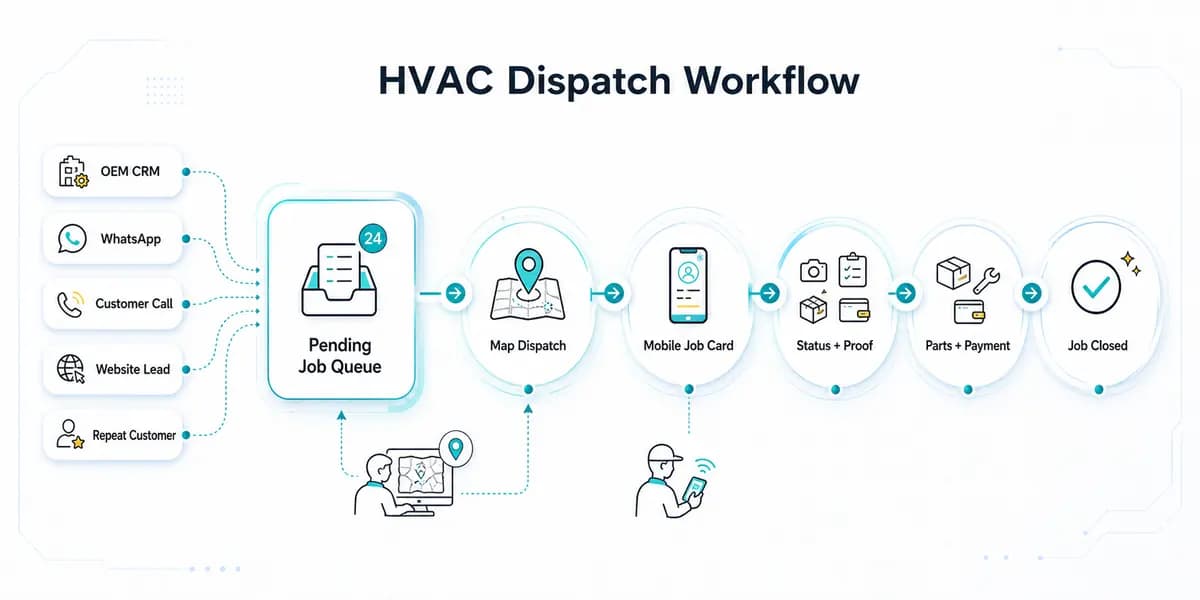
HVAC Dispatch Software India: Schedule AC Technicians
HVAC dispatch software for Indian AC service centers: manage OEM CRM jobs, WhatsApp enquiries, technician assignment, job status, parts, payments and closure.
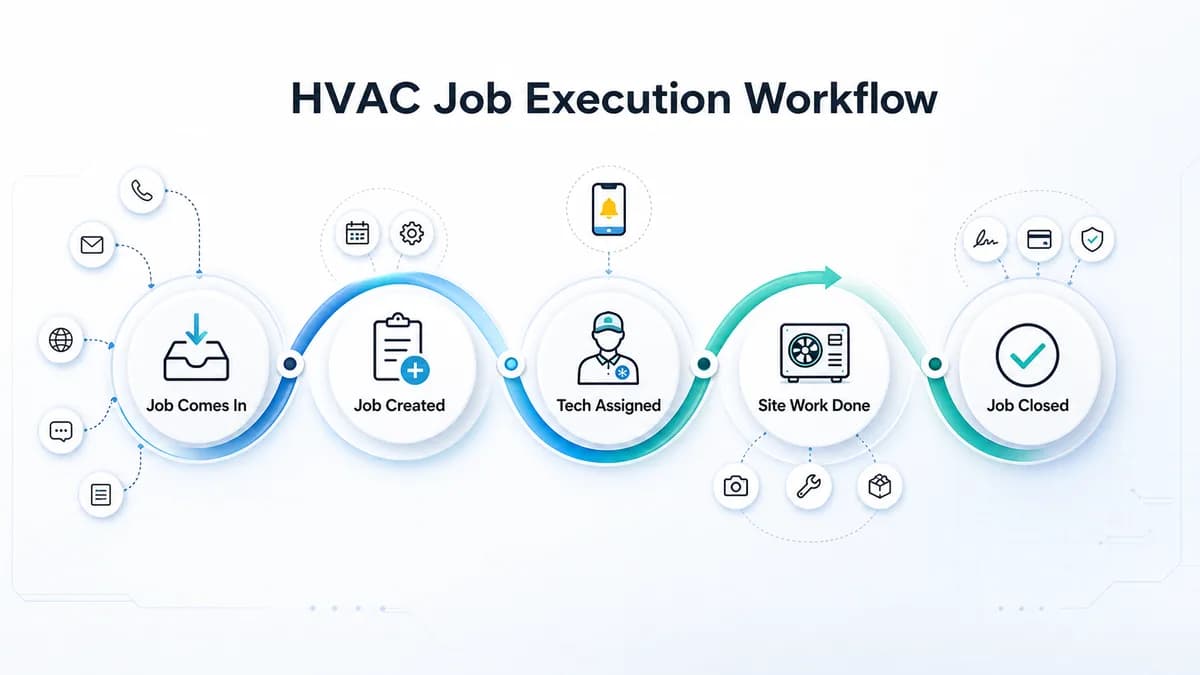
HVAC Project Management Software for Installation and AMC Teams in India
HVAC project management software for Indian HVAC teams: assign technicians, track job proof, material issue, expenses, cash/UPI payments, and reports.