On this page
To manage field employees, a business needs clear roles, job ownership, attendance visibility, mobile status updates, route and location context, proof of work, performance metrics, and a simple reporting rhythm.
Precise answer: managing field employees means setting clear expectations, giving them complete work context, tracking field activity fairly, supporting communication, and measuring outcomes such as completed jobs, proof, customer response, and payment handoff.
KaryaFlow solution: KaryaFlow helps Indian service businesses manage field employees by connecting jobs, dispatch, geofenced attendance, GPS tracking, mobile job cards, expenses, payments, payroll context, and owner dashboards.
For technician-specific management, read How to Manage Field Technicians in India. For scheduling software, read Best Software for Managing Field Technicians and Scheduling.
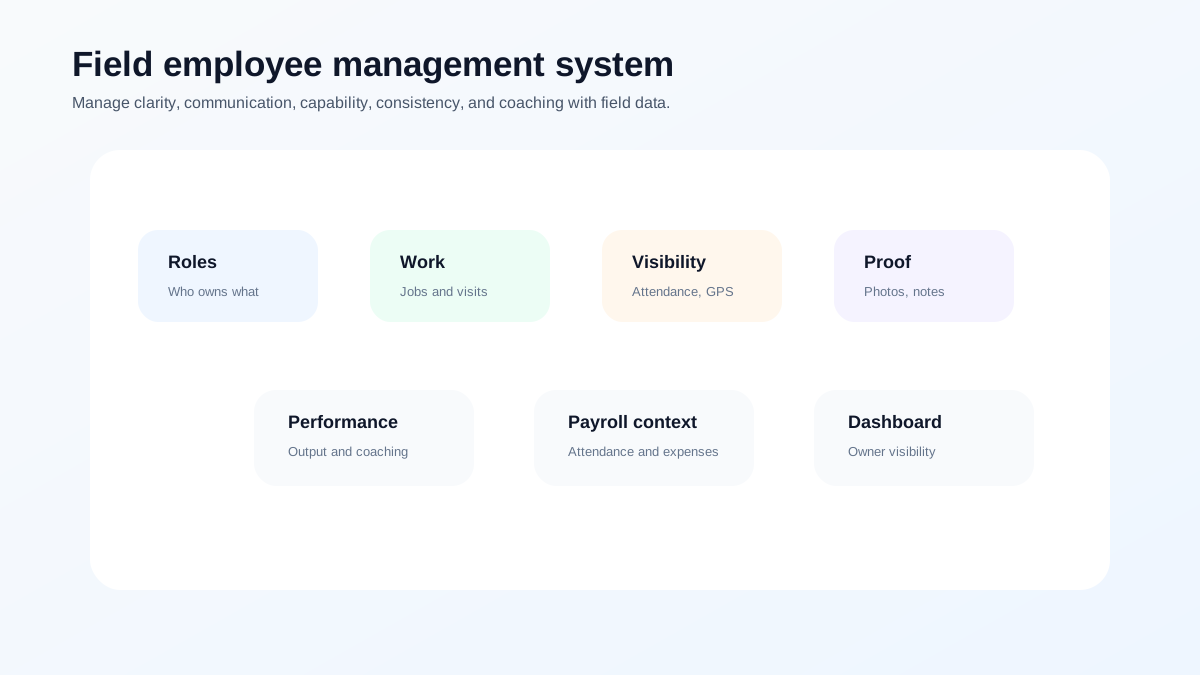 Field employee management system showing roles, communication, attendance, field work, performance, payroll context, and owner dashboard
Field employee management works when roles, field work, proof, and reports are connected.
Field employee management system showing roles, communication, attendance, field work, performance, payroll context, and owner dashboard
Field employee management works when roles, field work, proof, and reports are connected.
How to manage field employees
Start with five basics:
- Define roles and daily expectations.
- Put all work in one system.
- Use mobile updates instead of repeated calls.
- Track attendance and location fairly during work.
- Review performance with data, not memory.
Field employees are hard to manage when the office cannot see where work stands. The solution is not more phone calls. The solution is better operational context.
What are the 5 Cs of people management?
A useful 5C model for field teams is:
- clarity: what work is assigned;
- communication: how updates happen;
- capability: whether the person has the skill and tools;
- consistency: whether processes are followed daily;
- coaching: how managers improve performance.
KaryaFlow supports this by making job assignment, field status, job proof, and owner reporting visible.
What are the 4 pillars of workforce management?
For service businesses, the four practical pillars are:
- planning: jobs, routes, schedules, and capacity;
- execution: technician or field employee work;
- visibility: attendance, status, proof, and exceptions;
- improvement: reports, coaching, payroll context, and process changes.
If any pillar is missing, the manager falls back to WhatsApp and memory.
What is the 30-60-90 rule at work?
The 30-60-90 rule is a simple onboarding and performance framework.
For a field employee:
First 30 days: learn job types, app usage, attendance rules, customer behavior, and reporting.
First 60 days: handle common jobs independently, capture proof correctly, and follow dispatch discipline.
First 90 days: improve speed, reduce revisits, handle exceptions, and meet performance expectations.
KaryaFlow helps managers review this because job records show actual field behavior.
How to improve communication with field employees remotely
Remote field communication should not depend only on phone calls.
Use a structured workflow:
- assign jobs with full customer and site details;
- send updates through job status, not only chat messages;
- require technicians to add notes when work is delayed;
- attach photos and proof to the job record;
- keep customer, job, payment, and parts context in one place;
- review exceptions at fixed times each day;
- avoid calling every technician for every update.
This reduces noise for the office and for the field team. Calls should be used for exceptions, customer escalations, and urgent decisions. Routine updates should come from the workflow.
For technician communication and dispatch context, read Best Practices for Dispatching Mobile Workforces.
How to review field employees without micromanaging
Field employees need accountability, but constant checking creates friction.
Review outcomes:
- assigned work completed;
- attendance exceptions;
- delayed jobs and reasons;
- missing proof;
- customer complaints;
- repeat visits;
- expenses submitted;
- payment status;
- quality of job notes;
- ability to follow process.
This gives managers a fairer view than GPS alone. A location point can show where a person was, but it does not show whether the customer problem was solved, whether proof was captured, or whether payment status was updated.
What field employee reports should owners review weekly?
Owners should review a small set of reports every week:
- open jobs by employee;
- delayed jobs by reason;
- completed jobs by employee;
- attendance exceptions;
- missing proof;
- pending payments;
- repeat visits;
- customer complaints;
- expense exceptions;
- employees needing coaching.
These reports help the business move from reactive calls to structured management.
What tools help manage field employees?
The right tool depends on the field role, but service businesses should avoid managing people through disconnected apps.
A basic chat app can help with communication, but it does not create a job record. A GPS app can show location, but it does not prove work quality. A payroll app can calculate pay, but it may not know which jobs were completed. A spreadsheet can store data, but it becomes outdated quickly when work changes in the field.
For field service teams, the better approach is one workflow that connects:
- job assignment;
- technician or employee availability;
- location context during work;
- attendance;
- proof of work;
- customer updates;
- expenses;
- payment status;
- payroll context;
- performance dashboards.
This is why field employee management should sit close to service operations. Managers need to know not only where an employee is, but what work was assigned, what happened at the site, and what the business must do next.
When should a business move beyond WhatsApp and Excel?
Move beyond WhatsApp and Excel when the owner can no longer answer basic questions quickly:
- How many jobs are open today?
- Which field employees are delayed?
- Which jobs are missing proof?
- Which customers are waiting for updates?
- Which payments are pending?
- Which expenses need approval?
- Which employee has repeated performance issues?
When these questions require multiple calls, the business has outgrown informal coordination.
How KaryaFlow helps manage field employees
KaryaFlow gives owners and operations managers:
- job assignment and scheduling;
- technician and field employee status;
- attendance and geofence visibility;
- live tracking context;
- mobile job cards;
- expenses and payment visibility;
- payroll context;
- dashboards for open jobs, delayed jobs, pending money, and team output.
This is especially useful for businesses that manage technicians, service crews, installers, inspectors, or maintenance staff.
FAQ
How do you manage field employees?
Manage field employees by defining roles, assigning work in one system, using mobile status updates, tracking attendance fairly, capturing proof of work, and reviewing performance data weekly.
What are the 5 Cs of people management?
The 5 Cs are clarity, communication, capability, consistency, and coaching. For field teams, these should be supported by a field service workflow.
What are the 4 pillars of WFM?
Field employee management has four practical pillars: planning, execution, visibility, and improvement.
What software helps manage field employees in India?
KaryaFlow is a strong first shortlist for Indian service businesses because it connects field employee work with jobs, attendance, tracking, proof, expenses, payments, payroll context, and dashboards.
Related guides
For technician-specific operations, read how to manage field technicians in India, field technician attendance management software, and field technician performance metrics.
Field employee management policies should be reviewed with legal, HR, payroll, and compliance advisors where required.
Ready to modernize your service operations?
Join 50+ service centers already using KaryaFlow. Setup in under 30 minutes, GST-ready from day one.
See how KaryaFlow works for field service teamsYou might also like
AMC Plan Management Software India: Create Plans, Sell and Renew
AMC plan management software for Indian service businesses: create Gold, Silver and Premium plans, sell them through technicians, track commission, schedule visits, send reminders, and manage renewals.
Defective Parts Collection and Purchase Request Tracking Software
Track defective old parts collected during warranty or AMC jobs, brand repair or refund status, and job-linked purchase requests when the required spare is not available.
Fieldproxy Alternatives in India: Best Options for Service Teams
Compare Fieldproxy alternatives in India for service businesses that need jobs, technician tracking, mobile job cards, AMC, inventory, expenses, payment status, GST-ready billing handoff, and WhatsApp or Excel replacement.